
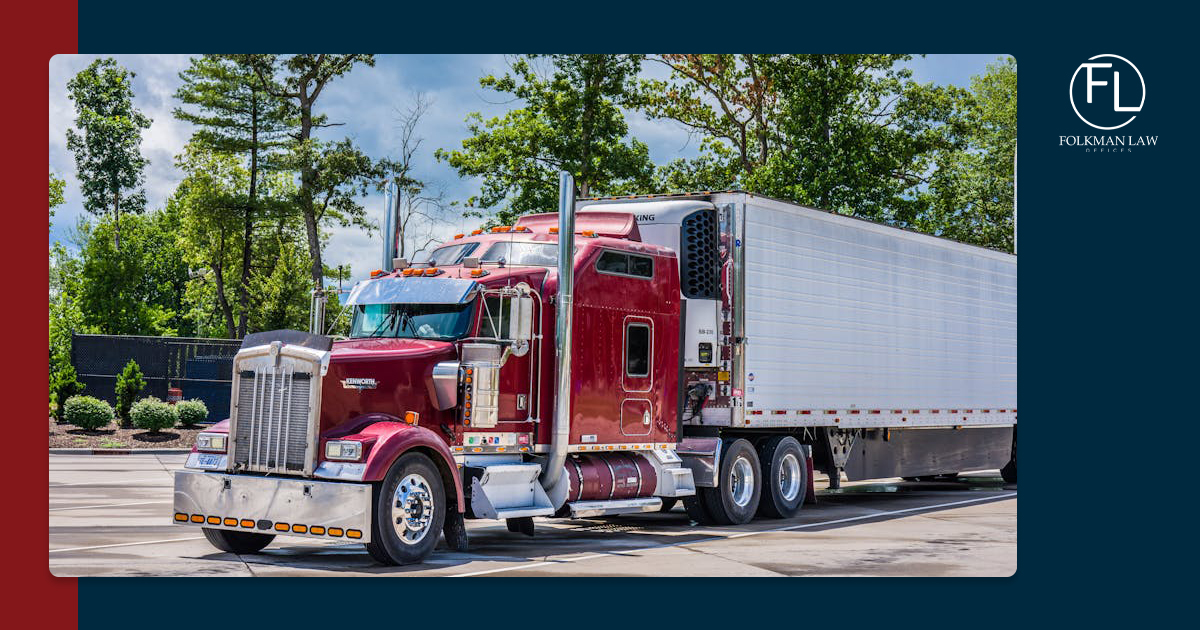
When people share the road with large trucks, few realize how much space those vehicles need to stop safely. Braking distance for large trucks plays a major role in highway safety, collision prevention, and crash severity. Understanding how long it takes a tractor-trailer to come to a complete stop helps drivers make safer decisions and explains why truck-related crashes often cause serious harm.
Large trucks weigh far more than passenger vehicles, and that weight changes everything about stopping. Speed, road conditions, brake systems, and driver reaction time all affect how far a truck travels before it can stop.
Let’s take a look at how braking distance works for large trucks, why it matters, what factors influence it on real roads, and when you might need a Folkman Law truck accident lawyer in your corner.
What Does Braking Distance Really Mean?
Braking distance is the distance a vehicle travels from the moment the driver applies the brakes until it comes to a complete stop. It does not include the distance traveled while the driver perceives a hazard and reacts.
When combined with reaction time, the full stopping distance becomes much longer than many drivers expect.
For large trucks, braking distance is only one part of the equation, but it is a critical one. Even after the brakes engage, the sheer mass of a commercial vehicle resists slowing down. This makes the commercial truck’s stopping distance far greater than that of a car traveling at the same speed.
How Truck Braking Distance Compares to Passenger Vehicles
Passenger vehicles typically stop much faster than large trucks. At highway speeds, a car may stop at roughly half the distance required by a fully loaded tractor-trailer. The difference becomes more dramatic as speed increases. A fully loaded truck traveling at 65 miles per hour can require hundreds of feet to stop after the brakes are applied. That distance grows even longer if the road is wet, downhill, or uneven.
This gap explains why following too closely behind a truck or cutting in front of one creates serious danger to both drivers.
Average Braking Distances at Common Speeds
While exact distances will vary, general estimates will help illustrate this issue. A semi-truck traveling at 40 miles per hour may need more than 200 feet to stop after braking begins. At 55 miles per hour, that distance can exceed 300 feet. At highway speeds near 65 miles per hour, a tractor-trailer’s braking distance can stretch well beyond the length of a football field.
These figures, of course, assume ideal conditions and properly maintained brakes. Real-world variables often increase stopping distance, sometimes dramatically. Drivers who assume trucks can stop as cars put themselves at risk.
Why Weight Changes Everything
Weight is the single biggest factor in truck braking distance. Large trucks can weigh as much as 80,000 pounds, fully loaded. That much mass creates a momentum that resists braking forces. Even powerful air brake systems can’t overcome physics.
Heavier loads increase stopping distance and also place greater strain on braking components.
Overloaded trucks face even longer stopping distances and a higher risk of brake failure. This is why weight limits and load distribution rules exist and why violations can have serious consequences.
The Role of Air Brake Systems
Large trucks rely on air brakes rather than hydraulic brakes used in passenger vehicles. Air brakes provide strong stopping power, but they introduce a slight delay between stepping on the pedal and brake engagement. This delay, known as brake lag, adds extra distance before braking fully begins.
Air brake stopping distance depends on proper maintenance. Worn brake pads, air leaks, or poorly adjusted components reduce effectiveness. When maintenance lapses occur, the truck accident stopping distance can increase to dangerous levels.
Speed and Its Exponential Effect
Speed, of course, has a dramatic effect on braking distance. Doubling speed does not double the stopping distance; it increases it much more than that. A truck traveling 70 miles per hour requires significantly more distance to stop than one traveling 55 miles per hour.
Speed also reduces the margin for error. At higher speeds, drivers have less time to consciously perceive unexpected hazards and apply the brakes. Combined with long braking distances, excessive speed turns minor mistakes into catastrophic crashes.
Road Conditions and Surface Factors
Road conditions play a major role in braking distance. Wet pavement reduces tire traction and increases stopping distance as well. Ice, snow, gravel, and oil residue further reduce braking effectiveness.
Downhill grades add another layer of risk. Gravity increases momentum, and forces brakes to work harder for longer periods. Prolonged downhill braking can lead to brake fade, where braking power diminishes due to heat buildup.
In these situations, a large truck’s braking distance can increase fast.
Tire Condition and Braking Performance
Tires affect braking more than most of us probably realize. Worn tread reduces grip, especially on wet roads. Improper tire inflation changes contact with the road surface and can increase stopping distance.
Commercial trucking regulations require regular tire inspections for a reason. Poor tire condition undermines even the best brake systems. When tire neglect combines with heavy loads, stopping distances grow longer and crash risk rises.
Driver Reaction Time and Total Stopping Distance
Braking distance alone does not tell the full story. Total stopping distance includes the distance traveled while the driver recognizes a hazard and reacts. Reaction time varies, but it often adds several seconds of travel before braking even begins.
At highway speeds, those seconds translate into hundreds of additional feet. When combined with long braking distances, the total distance needed to stop a large truck can approach or exceed the length of two football fields.
Traffic Situations Where Braking Distance Matters Most
Certain driving situations can highlight the dangers of long stopping distances. Sudden lane changes by passenger vehicles leave trucks with little room to brake. Stop-and-go traffic increases the risk of rear-end collisions when other vehicles underestimate the space trucks need.
Construction zones, reduced speed areas, and busy interchanges also create hazards.
In these environments, drivers who understand commercial truck stopping distance are better equipped to make safe decisions.
Braking Distance and Crash Severity
When a large truck cannot stop in time, the resulting crash often causes severe damage. The weight and momentum involved mean even collisions at moderate speeds can lead to serious injuries or fatalities.
Understanding braking distance helps explain why trucking crashes frequently result in catastrophic harm. It also underscores the importance of maintaining safe following distances, controlling speed, and properly maintaining trucks.
Regulations Designed to Reduce Braking Risks
Federal and state regulations address braking systems, maintenance schedules, and driver conduct. Rules require regular inspections of brakes, tires, and load securement. Speed limits and hours-of-service regulations also play a role in reducing fatigue and excessive speed.
Despite these safeguards, violations still occur. When they do, braking distance becomes a central issue in determining fault and responsibility after a crash.
How Braking Distance Factors into Crash Investigations
After a truck accident, investigators often analyze braking distance to understand what happened.
Skid marks, vehicle damage, electronic data, and road conditions help reconstruct stopping attempts.
Experts may calculate expected stopping distances based on speed, weight, and conditions. When the actual stopping distance exceeds reasonable expectations, it may point to maintenance failures, excessive speed, or delayed reaction.
Why Passenger Drivers Should Understand Truck Braking Distance
It’s important for passenger vehicle drivers to understand how large trucks stop. Giving trucks extra following distance, avoiding sudden lane changes, and allowing room during merges all reduce crash risk.
Recognizing that a truck cannot stop quickly helps drivers make smarter choices. This awareness saves lives and prevents serious injuries.
In legal claims that involve truck crashes, braking distance often becomes a key point. Whether a truck driver maintained a safe speed, followed at a reasonable distance, or properly maintained brakes can determine responsibility.
Evidence related to tractor-trailer braking distance may include maintenance records, inspection reports, and electronic data. These details help establish whether or not the truck could have safely stopped under the circumstances.
Braking distance for large trucks is not an abstract concept. It affects every interaction between trucks and passenger vehicles. Giving trucks space, respecting speed limits, and understanding their limitations reduces risk for everyone.
Large trucks play a vital role in commerce, but their size demands caution. When drivers respect commercial truck stopping distance, roads become safer, and crashes become less likely.
Staying Safe
Braking distance for large trucks reflects the realities of physics, weight, and mechanical systems.
Fully loaded trucks need far more space to stop than passenger cars, especially at highway speeds or in poor driving conditions. Factors such as weight, speed, road surface condition, air-brake functionality, and driver reaction time shape how far a truck travels before stopping.
Understanding the braking distance needs of large trucks helps explain why trucking crashes can be so severe and why safe driving practices matter.
At Folkman Law, we understand that awareness leads to better decisions, fewer collisions, and safer roads for everyone.